
Last updated: August 2026
If you’ve searched this question before, you’ve probably found conflicting answers — weekly, biweekly, “just water when it’s dry.” All of them can be right, because Monstera deliciosa doesn’t run on a calendar. It runs on how fast its soil dries out, and that depends on your light, pot, and climate. Here’s how to find your plant’s actual rhythm instead of guessing.
Quick answer: Water your Monstera deliciosa every 1–2 weeks, but only once the top 2–3 inches (5–7 cm) of soil have dried out. Check the soil before every watering — don’t water on a fixed schedule.
Watering is just one piece of keeping this plant thriving — see our complete Monstera deliciosa care guide for light, soil, humidity, and feeding too.
Why There’s No Single Right Number of Days
In its native Central American rainforests, Monstera deliciosa grows as a climbing, aerial-rooted vine, rooting into loose, fast-draining leaf litter and bark rather than a fixed bed of soil. Rain is frequent, but so is airflow and drainage — the roots rarely stay soaked for long. Indoor pots can’t replicate that airflow, which is exactly why generic “water once a week” advice causes so much root rot: what changes between homes is light, air movement, and soil, not the plant’s underlying preference for a wet-then-dry cycle.
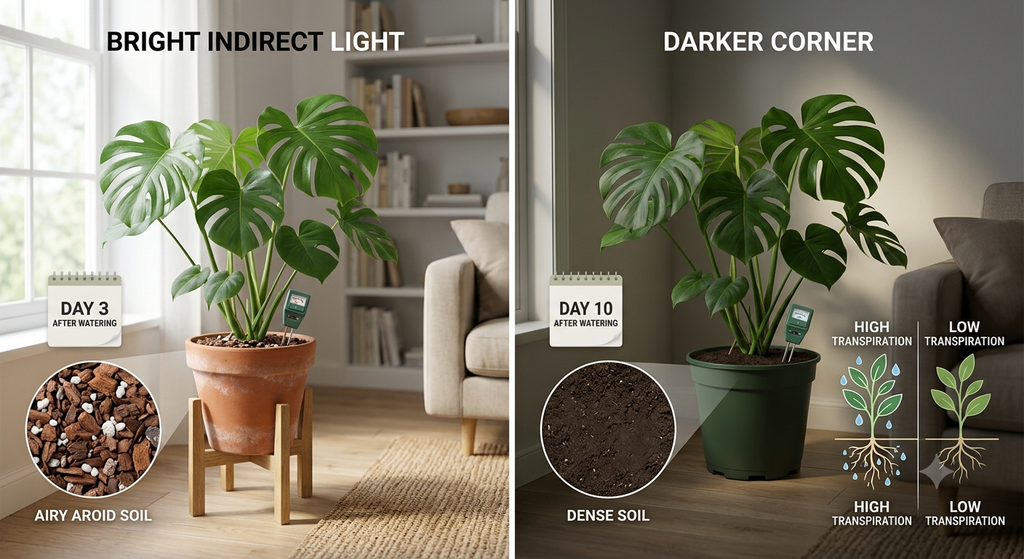
The real rule is simple: water thoroughly, then let the soil dry out significantly before watering again. How long that takes is different for every home.
6 Factors That Change Your Watering Frequency
| Factor | Dries out faster (water more often) | Stays moist longer (water less often) |
|---|---|---|
| Light | Bright, indirect light | Low light |
| Pot material | Terracotta / unglazed clay | Plastic or glazed ceramic |
| Soil mix | Chunky, well-draining (bark, perlite) | Dense, moisture-retentive mix |
| Humidity | Low humidity / air conditioning | High humidity |
| Temperature | Warm rooms (75–85°F / 24–29°C) | Cool rooms (below 65°F / 18°C) |
| Season | Spring and summer (active growth) | Fall and winter (semi-dormant) |
A Monstera in bright light and a terracotta pot might need water every 5–7 days in summer. The same plant in a dim corner in a plastic pot might comfortably go three weeks between waterings in winter — both are correct, for their own conditions. If you’re building good habits across your whole plant collection, our beginner’s guide to indoor plant care covers how pot material and light affect houseplants generally, not just Monstera.
How to Check If Your Monstera Actually Needs Water
Skip the calendar and check the plant instead:
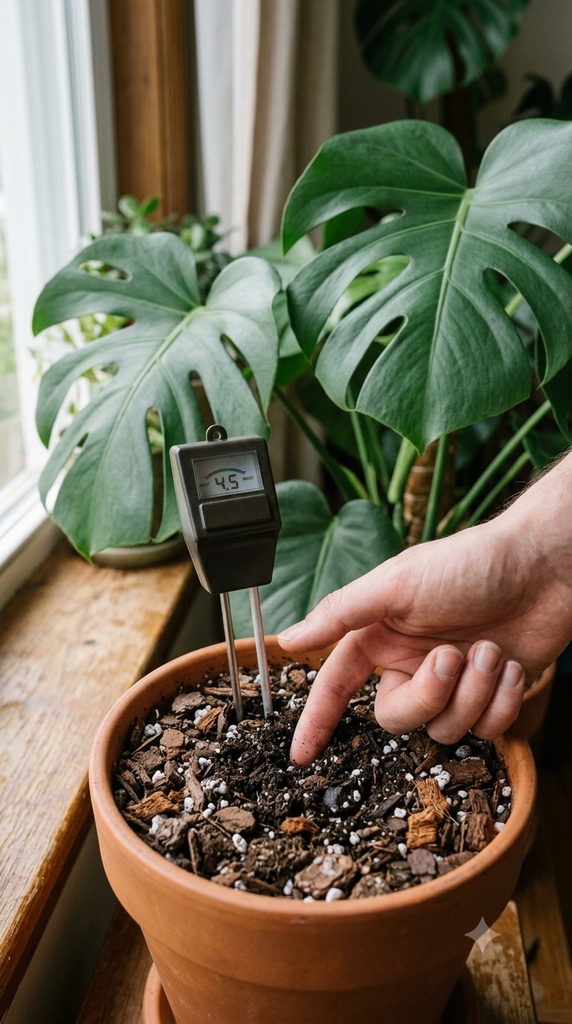
- Finger test: Push a finger into the soil to the second knuckle (about 2–3 inches). Water if it feels dry; wait if it feels cool or damp.
- Moisture meter: More reliable than a finger, especially in deep pots — it reads moisture lower in the root zone, not just the surface.
- Lift the pot: A dry pot is noticeably lighter than a freshly watered one. Once you’ve felt both a few times, weight becomes a fast gut-check.
- Leaf feel: Leaves that feel slightly softer than usual — before any visible drooping — are often the earliest sign the plant is ready to drink.
For more on reading soil moisture correctly — including how pot type and room conditions change the read — see our full guide on telling when an indoor plant needs water.
Signs of Overwatering
Overwatering is the more common mistake, and the more dangerous one — Penn State Extension notes that it’s a leading cause of root rot in Monstera deliciosa, which can damage the plant before you notice anything above the soil.
- Yellowing leaves, especially older ones, that feel soft rather than crispy
- Soil that’s still wet a week or more after watering
- A sour or musty smell from the pot
- Brown, mushy stems near the soil line
- Fungus gnats hovering around the pot
- Drooping leaves even though the soil is visibly wet
Signs of Underwatering
- Leaves curling or drooping, but perking back up soon after watering
- Dry, crispy brown edges or tips
- Soil visibly pulling away from the sides of the pot
- Slower growth and smaller new leaves
- Lower leaves yellowing while feeling dry and papery, not soft
The tricky overlap: both overwatering and underwatering cause drooping leaves. The soil is what tells them apart — wet soil with droopy leaves points to root rot risk; dry, pulled-away soil with droopy leaves points to thirst.
How to Water a Monstera Deliciosa Correctly
- Water until it drains. Pour slowly around the base until water runs from the drainage holes, so the whole root ball gets moisture, not just the top layer.
- Always use a pot with drainage holes. Without one, excess water pools at the bottom and root rot becomes likely no matter how carefully you time waterings.
- Empty the saucer. Leaving the pot sitting in standing water re-saturates the soil from below and undoes step 1.
- Use room-temperature water. Cold water can shock the roots. Tap water is generally fine unless your local supply is very hard or heavily chlorinated, in which case filtered or 24-hour-rested water helps.
- Water the soil, not just the leaves. Misting raises humidity slightly but doesn’t reach the roots — it’s a supplement to watering, not a substitute.
- Try bottom watering occasionally. Set the pot in a basin of water for 15–20 minutes so moisture wicks up through the drainage holes, then let it drain fully. This encourages deeper root growth, but alternate it with top watering so mineral salts don’t build up in the soil.
Seasonal Watering Schedule (General Guide)
| Season | Typical frequency | Why |
|---|---|---|
| Spring / Summer | Every 7–10 days | Active growth, more light, higher water use |
| Fall | Every 10–14 days | Growth slows as light and temperature drop |
| Winter | Every 14–21 days | Semi-dormant; overwatering risk is highest |
Treat this table as a starting point, not a rule. Confirm with the finger test or a moisture meter before every watering.
FAQs About Watering Monstera Deliciosa
Should I water my Monstera on a fixed schedule?
No. A fixed schedule ignores changes in season, light, and humidity, and is the most common cause of both over- and underwatering. Check the soil each time instead.
How much water does a Monstera need per watering?
Enough to fully saturate the root ball until water drains from the bottom. There’s no fixed cup measurement — pot size and soil volume vary too much between plants.
Can misting replace watering?
No. Misting adds humidity around the leaves but doesn’t reach the roots, which is where the plant actually absorbs water.
Is tap water safe for Monstera deliciosa?
Usually. If your tap water is very hard, softened, or heavily chlorinated, filtered or rested (24-hour) water reduces the risk of leaf tip burn over time.
Why does my Monstera droop even after I water it?
Persistent drooping after watering often points to root damage from previous overwatering rather than current thirst. Check for soft, dark roots at the next repotting.
Does a bigger pot mean I should water more often?
The opposite, generally. More soil volume holds moisture longer, so larger pots typically need less frequent watering than snug ones.
The Bottom Line
- There’s no universal “every X days” rule — water when the top 2–3 inches of soil are dry, not on a calendar.
- Light, pot material, soil mix, humidity, and season all change how fast that happens.
- When in doubt, lean toward underwatering — Monstera recovers from thirst far more easily than from root rot.
- Check the soil before every watering, and you’ll avoid nearly every common Monstera watering mistake.
Always adapt watering to your plant, light level and season rather than following a rigid calendar.