
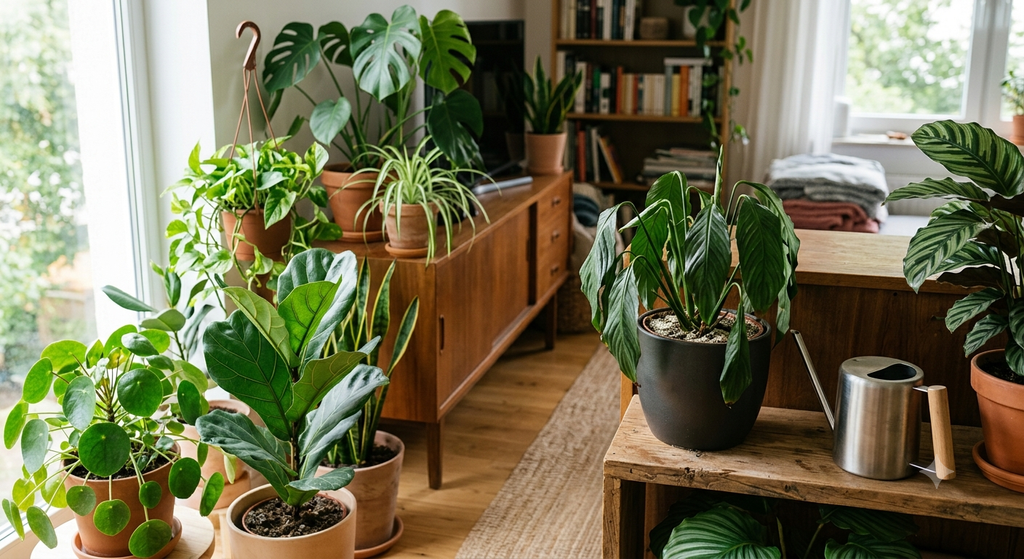
Wondering whether your indoor plant is actually thirsty or whether you are about to give it too much water? The answer usually starts with the soil, not the calendar.
There is no universal watering schedule that works for every houseplant. A plant in a bright, warm room may dry out much faster than the same plant in a cool, dim corner. Pot size, soil type, pot material, humidity, and the plant itself all matter.
The good news is that you do not need to guess.
In this guide, you will learn how to tell when an indoor plant needs water, how to recognize the difference between underwatering and overwatering, and how to build a watering routine around your plant’s actual needs.
The Quickest Way to Tell if an Indoor Plant Needs Water
Before adding water, check the moisture in the soil.
For most common houseplants, push your finger about 1–2 inches (2.5–5 cm) into the soil. If the soil feels dry at that depth, watering may be appropriate. If it still feels moist, wait and check again later.
The important point is that the correct depth depends on the plant.
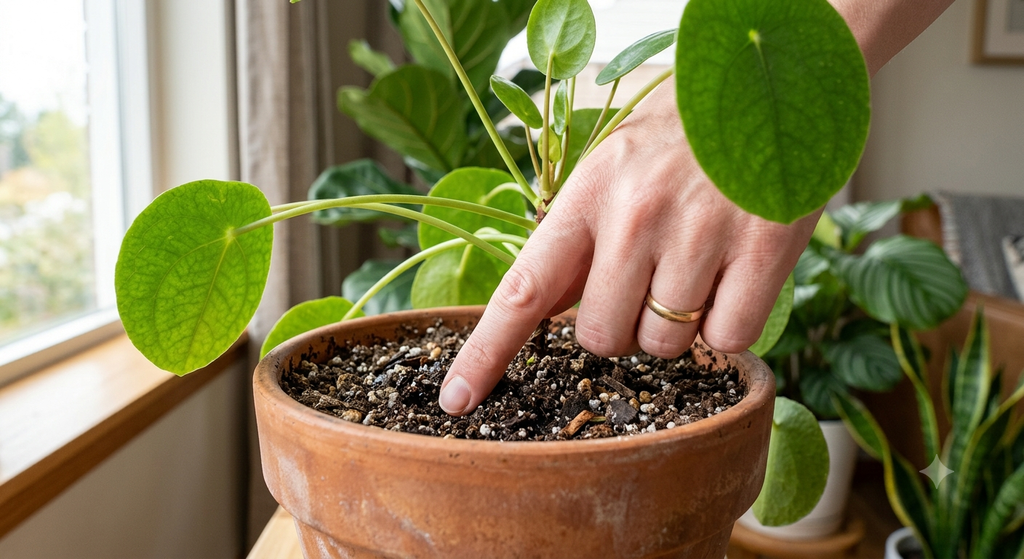
A shallow-rooted plant may need checking closer to the surface, while a larger plant in a deep pot may need a deeper moisture check.
Do not rely only on the appearance of the top layer. Surface soil can look dry while the lower part of the root zone is still moist.
1. Use the Finger Test
The finger test is one of the simplest ways to check soil moisture.
How to do it
Insert your finger into the soil and feel for moisture below the surface.
- If the soil feels dry several centimeters down, it may be time to water.
- If the soil feels cool and moist, wait.
- If the soil is slightly damp, check again in a day or two.
Avoid treating one reading as a universal rule. Different plants prefer different moisture levels.
For example, a cactus and a tropical fern should not be watered using the same dry-to-wet routine — see their individual care pages for species-specific moisture preferences.
2. Lift the Pot
Another useful method is surprisingly simple: pick up the pot.
After thoroughly watering a plant, notice how heavy the container feels. Then check it again as the soil dries.
A noticeably lighter pot often indicates that a substantial amount of moisture has been lost.
This method becomes especially useful once you get used to the normal weight of your plants.
A simple routine
Water your plant normally, lift the pot, and remember its weight.
Check it again over the next several days.
Over time, you will become much better at recognizing when a plant is genuinely becoming dry.
3. Look at the Leaves—but Do Not Rely on Them Alone
Leaves can provide useful clues, but wilting is not proof that a plant needs water.
Both underwatering and overwatering can cause leaves to droop.
Common signs of underwatering
Depending on the plant, you may notice:
- Drooping leaves
- Dry or crispy leaf edges
- Brown, dry tips
- Soil that has become very dry
- Soil pulling away from the sides of the pot
- Leaves becoming thinner, curled, or less firm
Plants experiencing prolonged underwatering may also stop producing healthy new growth.
Common signs of overwatering
Possible signs include:
- Soil that stays wet for a long time
- Yellowing leaves
- Soft or unusually limp foliage
- Leaves dropping despite wet soil
- Mushy stems or roots
- An unpleasant smell from the soil
- Persistent fungus gnats or other signs of constantly damp soil
The key difference is not simply whether the leaves are drooping.
Always compare the plant’s symptoms with the moisture level of the soil. If you are unsure what is typical for your specific plant, check its entry in the plant database for species-specific symptom guidance.
Underwatering vs. Overwatering: Quick Comparison
| Sign | Underwatering | Overwatering |
|---|---|---|
| Soil | Very dry | Stays wet for a long time |
| Leaves | Often dry, crispy, curled | Often soft, yellowing, or limp |
| Wilting | Common | Also possible |
| Leaf edges | Brown and crispy | May become yellow or soft |
| Roots | Dry or brittle | May become dark, mushy, or damaged |
| Pot weight | Very light | Remains relatively heavy |
| Smell | Usually normal | May smell sour or rotten |
These symptoms are clues, not guarantees. Plant species behave differently, so always consider the specific plant.
4. Check the Soil Color and Texture
Soil can also tell you a lot.
Dry soil often appears lighter and may feel loose or dusty. Moist soil is usually darker and holds together more easily.
However, appearance alone can be misleading.
Peat-based mixes, coco coir, bark-heavy mixes, and other potting materials can behave differently as they dry.
That is why touching the soil is usually more informative than simply looking at it.
5. Use a Moisture Meter When It Helps
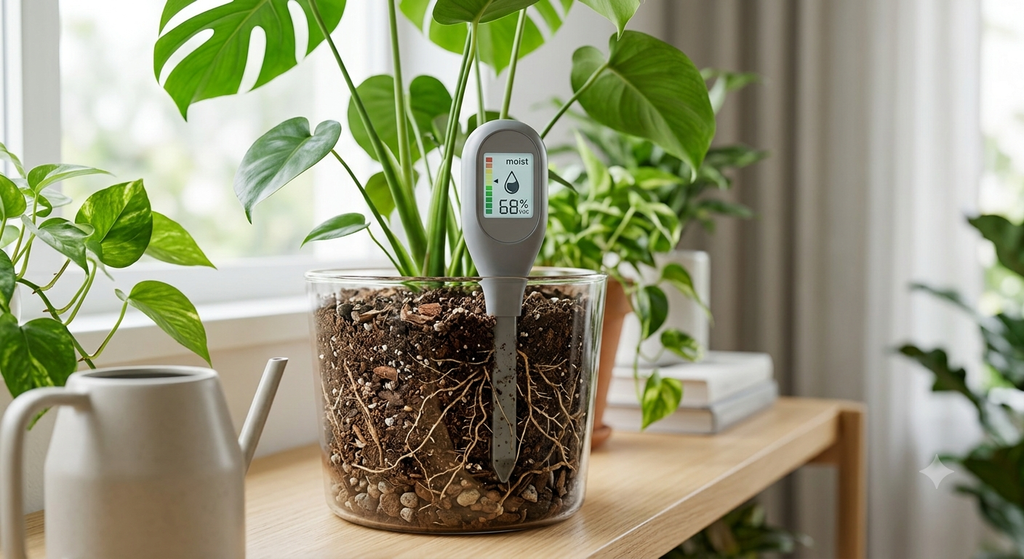
A moisture meter can be useful for large pots or for plants where it is difficult to judge moisture by hand.
Insert the probe into the root zone and take a reading rather than measuring only the top layer.
A moisture meter should be treated as a guide rather than an absolute answer. Different meters and potting mixes can produce different readings, and plant preferences vary.
For many common houseplants, learning to judge soil by touch is enough.
6. Check the Pot and Drainage
Your container affects how quickly the soil dries.
Pots with drainage holes
Containers with drainage holes allow excess water to escape, reducing the chance that the root zone stays saturated.
After watering, allow excess water to drain away rather than leaving the pot sitting in a saucer full of water for extended periods.
Pots without drainage holes
Be especially careful with decorative pots that do not have drainage holes.
Because excess water has nowhere to go, it is much easier to keep the root zone too wet.
For beginners, a nursery pot with drainage holes placed inside a decorative cover pot is often a safer setup.
7. Consider the Plant’s Environment
How quickly a plant dries out depends heavily on its surroundings.
You may need to check moisture more often when:
The plant receives more light
Bright light can increase plant activity and can cause the growing medium to dry more quickly.
The room is warm
Higher temperatures can increase water loss from both the plant and the potting mix.
The air is very dry
Low indoor humidity can increase water loss, especially for plants with large or thin leaves.
The plant is near heating or air conditioning
Air movement and dry air can change how quickly the plant loses moisture.
The pot is made from unglazed terracotta
Terracotta is porous and can allow the potting mix to dry faster than some plastic or glazed containers.
This is one reason two identical plants can require different watering intervals in different rooms.
8. Consider the Season—But Do Not Follow a Calendar
Many indoor plants use less water during periods of slower growth, particularly when light levels fall.
However, you should not automatically cut watering in half just because the season changed.
Instead, monitor the plant.
During periods of strong growth and brighter light, the soil may dry faster.
During darker or cooler periods, the same plant may stay moist for much longer.
The best approach is to adjust your watering based on the actual condition of the soil.
9. Know When Different Plants Prefer to Dry Out
Not all houseplants should be allowed to become completely dry.
Plants that often prefer some drying between waterings
Many succulents, cacti, snake plants, and other drought-tolerant plants prefer the potting mix to dry substantially before they are watered again.
Plants that prefer more consistent moisture
Some tropical plants, including many ferns, and other moisture-loving species perform better when the growing medium remains lightly and consistently moist rather than becoming bone dry.
This is why identifying your plant correctly can make watering much easier. Browse the plant database to find your specific plant’s moisture preference before you settle into a routine.
Approximate Watering Frequency by Plant Type
Once you understand your plant’s general category, you can use the table below as a rough starting interval — always confirm with a soil check before watering, since light, pot size, and season will shift these numbers in either direction.
| Plant category | Typical indoor watering interval | Drying preference between waterings |
|---|---|---|
| Desert succulents & cacti | Every 2–4 weeks | Allow soil to dry out almost completely |
| Semi-succulent (e.g. snake plant, ZZ plant) | Every 2–3 weeks | Allow top two-thirds of soil to dry |
| Tropical foliage (e.g. pothos, philodendron) | Every 7–10 days | Allow top 1–2 inches to dry |
| Moisture-loving tropicals (e.g. ferns, calathea) | Every 4–7 days | Keep lightly, consistently moist |
| Flowering houseplants (e.g. peace lily, African violet) | Every 5–8 days | Allow slight surface drying only |
| Orchids (bark or moss mix) | Every 7–14 days | Let roots approach dryness; avoid standing water |
These intervals assume average indoor light and room temperature. A plant sitting in a bright south-facing window or a heated room will likely need water more often than this table suggests, and a plant in a dim corner will likely need it less often. Treat this as a starting point to check against, not a fixed schedule — see the earlier sections on environment and the finger test for how to confirm what the soil is actually doing.
How Much Water Should You Give an Indoor Plant?
Knowing when to water is only half of the process.
For many plants grown in containers with drainage holes, a thorough watering is preferable to giving only a small splash each time.
Water slowly until the growing medium is evenly moistened and some excess water begins to drain from the bottom.
Then allow the pot to drain fully.
The exact amount depends on the plant, pot size, soil mix, and container.
Why small amounts of water can be a problem
Giving a plant just a few drops or a small cup every few days may wet only the upper layer of soil.
This can leave the deeper root zone unevenly moist.
Instead of watering according to a fixed amount, focus on evenly moistening the root zone and then allowing the soil to dry to the level preferred by that plant.
What If Water Runs Straight Through the Bottom?
Sometimes water can move rapidly through a dry potting mix instead of spreading evenly through it.
This can happen when the soil has become extremely dry or has developed gaps between the pot and the root ball.
In that situation, watering slowly and thoroughly may help rehydrate the mix.
For severely dried-out plants, some growers use bottom watering temporarily so the root ball can absorb moisture more evenly.
Do not assume that fast drainage automatically means the soil is hydrophobic. It can also be a normal result of the soil structure and the amount of water being applied.
Should You Water Immediately When a Plant Wilts?
Not necessarily.
First check the soil.
If the plant is wilted and the soil is dry, underwatering is a likely possibility.
If the plant is wilted while the soil is consistently wet, adding more water may make the underlying problem worse.
Other issues — including root damage, temperature stress, pests, insufficient light, or transplant shock — can also cause wilting. Each of these has its own tell-tale signs beyond the wilting itself, which is why checking the soil first, then looking for these secondary signs, gives a clearer picture than the wilting alone.
Heat or temperature stress
Wilting caused by heat rather than dry soil often comes with signs that point to the plant’s location rather than its roots:
- Leaves wilt primarily on the side of the plant closest to a window, heater, or radiator
- The wilting is worse in the afternoon and partly recovers overnight once the room cools
- Leaf edges or tips look scorched or bleached rather than simply dry and crispy
- The soil underneath is still noticeably moist despite the drooping
If these patterns match what you are seeing, moving the plant away from the heat source is usually more useful than watering it again.
Pest-related wilting
Pests can cause wilting that looks similar to underwatering at first glance, but usually come with additional clues on close inspection:
- Fine webbing on the undersides of leaves or between stems, often from spider mites
- Small clusters of white, cottony fluff in leaf joints, typical of mealybugs
- Sticky residue on leaves or on the surface below the plant (honeydew from sap-sucking insects such as aphids or scale)
- Tiny flying insects that scatter when the soil surface is disturbed, usually fungus gnats, which point to overly wet soil rather than dryness
- Stippled or speckled discoloration on leaves rather than uniform drooping
A soil check will not reveal a pest problem, so if the moisture level does not explain the wilting, it is worth turning a few leaves over and inspecting the stems closely before watering again.
Think of wilting as a signal to investigate, not an automatic instruction to water.
How Often Should You Water Indoor Plants?
Instead of asking, “How often should I water this plant?” ask:
“How quickly does this particular plant’s soil dry out in my environment?”
A watering interval can change because of:
- Plant species
- Pot size
- Soil composition
- Drainage
- Light level
- Temperature
- Humidity
- Season
- Root size
A plant might need watering several times a week in one environment and much less often in another.
That is why a fixed seven-day schedule often fails.
A Simple Houseplant Watering Routine
You can make watering much easier by following the same quick process each time.
Step 1: Check the plant
Look at the leaves and overall appearance.
Step 2: Check the soil
Use your finger or another suitable method to assess moisture below the surface.
Step 3: Consider the plant
Ask what this particular species prefers. Check the plant database if you are unsure.
Step 4: Check the pot
Make sure it has appropriate drainage and that excess water is not sitting around the roots.
Step 5: Water thoroughly when needed
Moisten the root zone appropriately and let excess water drain away.
Step 6: Recheck later
Do not water again simply because several days have passed. Check the soil first.
Common Watering Mistakes to Avoid
Watering every Sunday
A calendar cannot tell you how quickly your plant’s soil has dried.
Watering because the leaves are drooping
Wilting can happen for several reasons, including overwatering, heat stress, and pests — not just dry soil.
Giving only a tiny amount each time
This may leave parts of the root zone dry.
Ignoring drainage
Poor drainage can keep roots wet for too long.
Treating every plant the same
A cactus, pothos, fern, and orchid can have very different watering requirements.
Checking only the soil surface
The top layer can dry much faster than the deeper root zone.
Frequently Asked Questions
How can I tell if my indoor plant needs water?
Check the moisture of the soil below the surface and compare it with the plant’s preferred moisture level. Also consider the pot’s weight and look for signs of underwatering or overwatering.
Is it better to water plants in the morning?
Morning is a convenient time for watering, but the most important factor is watering when the plant actually needs it. Indoor conditions vary, so timing is less important than appropriate moisture and drainage.
Can yellow leaves mean a plant needs water?
Yes, but yellow leaves are not a reliable sign of underwatering by themselves. Overwatering, natural aging, nutrient issues, insufficient light, and other problems can also cause yellowing.
Should I let indoor plant soil dry completely?
It depends on the plant. Drought-tolerant species like cacti and succulents often prefer significant drying between waterings, while some moisture-loving plants like ferns prefer more consistent moisture. Check the plant database for your specific plant.
How do I know if I am overwatering?
Look for soil that remains wet for unusually long periods, yellowing or soft leaves, persistent wilting despite wet soil, and signs of root or stem damage. The plant and growing conditions should always be considered together.
Can I use a moisture meter for all houseplants?
You can use one as a helpful tool, especially for larger pots, but moisture meters are not a substitute for understanding the plant’s preferences and checking the growing medium properly.
Final Thoughts
Learning when to water an indoor plant is less about following a perfect schedule and more about learning to read your plant and its growing environment.
Start with the soil.
Check below the surface, pay attention to the weight of the pot, observe the leaves, and understand what your particular plant prefers.
Over time, you will stop guessing and start recognizing the signs naturally.
The goal is not to water your plants on a fixed schedule.
The goal is to give them water when they actually need it.
Plantify tip
Always adapt watering to your plant, light level and season rather than following a rigid calendar. For plant-specific guidance, browse the full plant database.
Always adapt watering to your plant, light level and season rather than following a rigid calendar.